
The Art of Customer-Centric Success: Inside What is HubSpot’s Revolutionary Sales Approach
What is Hubspot? In 2006, a small startup launched with a radical idea—what if sales and marketing could actually help customers instead of interrupting them? Today, HubSpot serves over 200,000 businesses across 120 countries, transforming how companies connect with their audiences.
The traditional sales funnel is dead. Long live the flywheel.
HubSpot didn’t just build software; they engineered a movement that redefined business growth for the digital age. Their approach? Put the customer at the center of everything. Revolutionary? Yes. Effective? Absolutely.
I’ve spent years watching companies struggle with disconnected systems and frustrated customers. HubSpot’s integrated platform and methodology offers something genuinely different. Let’s dive into what makes their approach work—and how your business can benefit from these principles even if you never purchase their software.
What Is HubSpot Exactly?
At its core, HubSpot is a comprehensive customer relationship management (CRM) platform designed to align sales, marketing, and service teams. But that simple definition misses the bigger picture.
HubSpot represents an entire philosophy about how businesses should operate in the digital age. They call it “inbound.”
The company was founded by Brian Halligan and Dharmesh Shah, two MIT graduates who recognized a fundamental shift in buyer behavior. People were increasingly resistant to traditional outbound marketing tactics. Cold calls went unanswered. Promotional emails languished in spam folders. TV commercials got skipped.
Something had to change.
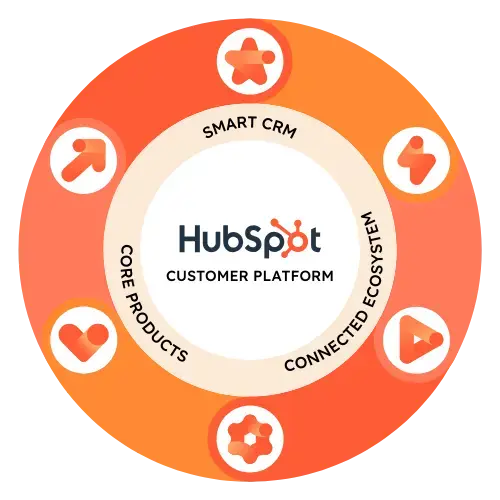
HubSpot built their platform around a radical concept: help first, sell second. Their software suite includes:
- Marketing Hub: Attract visitors and convert leads
- Sales Hub: Close more deals with less friction
- Service Hub: Turn customers into promoters
- CMS Hub: Manage website content with built-in optimization
- Operations Hub: Connect and clean up customer data across systems
Each component works seamlessly with the others. Everything feeds into a centralized CRM that’s completely free to use. Yes, free!
But HubSpot isn’t just selling software. They’re selling a better way to do business.
The Inbound Methodology: What is HubSpot’s Foundation
Traditional sales approaches focus on finding customers. HubSpot’s inbound methodology flips the script: it helps customers find you.
What is Hubspot way put in practice:
- Attract: Create valuable content that addresses real problems your potential customers face
- Engage: Build relationships through personalized, helpful interactions
- Delight: Continue providing value long after the sale
This methodology drives everything What is HubSpot does. Their software simply makes implementation easier.
“The best companies today aren’t selling to customers; they’re solving for them,” says HubSpot co-founder Dharmesh Shah. This fundamental shift in thinking underpins their entire sales approach.
Consider the contrast with traditional sales techniques:
|
Traditional Sales |
HubSpot’s Approach |
|---|---|
|
Interrupt with cold calls |
Educate with helpful content |
|
Generic mass emails |
Personalized, targeted communication |
|
Pressure tactics |
Consultative guidance |
|
Transaction-focused |
Relationship-focused |
|
Sales-centric metrics |
Customer success metrics |
The results speak for themselves. Companies using inbound marketing generate 54% more leads than traditional outbound methods at a significantly lower cost per lead.
But what makes this approach truly revolutionary is how it aligns with modern buyer behavior.
Understanding the Modern Buyer’s Journey
Today’s buyers are more informed and empowered than ever before. Research shows that 70-80% of the decision-making process happens before a prospect ever talks to sales.
HubSpot recognized this shift early and built their sales approach around it.
The modern buyer’s journey typically includes:
- Awareness: “I have a problem or opportunity”
- Consideration: “What are my options for solving this?”
- Decision: “Which solution is best for me?”
What is HubSpot’s sales methodology maps perfectly to this journey. They create awareness-stage content that identifies common problems. Their consideration-stage resources educate buyers about potential solutions. And their decision-stage materials highlight why their approach works best.
This alignment feels natural to prospects. There’s no jarring disconnect between marketing promises and sales conversations.
Every interaction builds upon the last, creating momentum that carries prospects toward becoming customers—and customers toward becoming promoters.
Which brings us to perhaps HubSpot’s most influential contribution to sales thinking: the Flywheel.
From Funnel to Flywheel: What is HubSpot’s Paradigm Shift
For decades, businesses visualized the customer journey as a funnel. Prospects entered at the top, moved through various stages, and exited as customers at the bottom.
Then what? The funnel model simply ended.
HubSpot CEO Brian Halligan introduced a better metaphor in 2018: the flywheel.
A flywheel is a mechanical device that stores energy. The more force applied, the faster it spins. Reducing friction makes it spin even faster.
Applied to business:
- Force = the efforts you put into attracting, engaging, and delighting customers
- Friction = anything that slows down the customer experience
- Momentum = the growth that comes when satisfied customers drive referrals
This model recognizes something the funnel ignores: happy customers are your best growth engine.
The brilliant insight here is that customer success doesn’t just generate repeat business—it creates a powerful referral engine. When your existing customers succeed, they bring new prospects into your orbit.
HubSpot’s entire sales approach centers on maximizing flywheel momentum by:
- Increasing force through aligned teams and customer-centric strategies
- Reducing friction by eliminating pain points in the customer experience
- Leveraging customer success to drive referrals and testimonials
The results can be extraordinary. Companies with highly-engaged customers see 23% more revenue growth than average.
But how does this philosophy translate into day-to-day sales practices?
Inside the tool, What is HubSpot’s Sales Methodology
What is HubSpot’s sales methodology? Well it isn’t just theory—it’s a practical framework their own sales team uses daily. They call it “GPCT”:
- Goals: What is the prospect trying to achieve?
- Plans: What’s their strategy for reaching those goals?
- Challenges: What obstacles stand in their way?
- Timeline: When do they need to solve this problem?
This framework shifts conversations away from features and prices toward value and outcomes. It positions salespeople as consultants rather than pitchers.
Dan Tyre, one of HubSpot’s first sales hires, explains: “Modern buyers don’t want to be sold to—they want to be helped.”
HubSpot trains their sales team to execute this methodology through a five-step process:
- Identify: Find prospects with problems you can solve
- Connect: Establish rapport and understand their situation
- Explore: Dig deeper into goals, plans, challenges, and timeline
- Advise: Present solutions tailored to their specific needs
- Close: Make it easy to say yes and begin implementation
What’s striking about this approach is how much emphasis it places on the pre-solution stages. HubSpot salespeople are taught to thoroughly understand a prospect’s situation before proposing solutions.
This patience pays off. Their sales team regularly achieves close rates far above industry averages.
But methodology alone isn’t enough. HubSpot’s success also stems from how they structure their sales organization.
What is HubSpot’s Sales Team Structure: Built for Buyer Success
Traditional sales organizations often create internal competition that ultimately hurts customers. HubSpot takes a different approach.
Their sales structure includes specialized roles designed to serve buyers at each stage of their journey:
- Inbound Sales Representatives: Handle initial inquiries and qualify leads
- Account Executives: Work with qualified prospects to identify solutions
- Solutions Engineers: Provide technical expertise during the sales process
- Implementation Specialists: Ensure smooth onboarding after purchase
- Customer Success Managers: Help customers achieve long-term goals
This specialization allows each team member to develop deep expertise in their area. More importantly, it creates a seamless experience for customers as they move through their buying journey.
HubSpot also pioneered the concept of “smarketing”—the tight alignment between sales and marketing teams. They accomplish this through:
- Shared goals and metrics
- Regular communication channels
- Joint planning sessions
- Transparent access to information
- Feedback loops for continuous improvement
This alignment eliminates the traditional rivalry between these departments. When sales and marketing work together, prospects receive consistent messaging from first touch to final close.
The results are impressive. Companies with strong sales-marketing alignment achieve 20% annual revenue growth on average, compared to 4% decline for companies with poor alignment.
But perhaps the most distinctive aspect of HubSpot’s sales approach is their commitment to transparency.
Radical Transparency: What is HubSpot’s Secret Weapon
In an industry known for hidden fees and bait-and-switch tactics, HubSpot embraces radical transparency with both prospects and customers.
Their pricing is clearly published on their website. Their contracts don’t contain hidden traps. Their salespeople are encouraged to be forthright about what the product can and cannot do.
This transparency extends to their own internal culture. HubSpot published their Culture Code deck in 2013, which has now been viewed over 6 million times. It openly shares their values, practices, and aspirations.
As co-founder Dharmesh Shah explains: “In a world where transparency is the default, you’re better off being proactively transparent rather than having transparency forced upon you.”
This transparency creates trust—the essential foundation for any successful sales relationship. When prospects know exactly what they’re getting, they’re more likely to commit and less likely to feel buyer’s remorse later.
But trust must be backed by substance. That’s where HubSpot’s focus on providing genuine value comes in.
The Value-First Approach to Sales
HubSpot pioneered what might be called “value-forward selling.” Their sales process delivers significant value before asking for any commitment.
This approach manifests in several ways:
- Free Tools: HubSpot offers numerous free tools that deliver immediate value
- Educational Content: Their blog, academy, and certification programs provide substantial education at no cost
- Assessment Tools: Prospects can evaluate their current performance and identify improvement opportunities
- Templates and Resources: Ready-to-use materials help solve immediate challenges
By the time a prospect engages with sales, they’ve often received significant value from HubSpot. This creates reciprocity and demonstrates the company’s expertise.
More importantly, it proves HubSpot’s commitment to the prospect’s success. As Jon Dick, HubSpot’s VP of Marketing, puts it: “We don’t consider marketing or sales successful if our customers aren’t successful.”
This value-first philosophy permeates their entire sales process:
- Discovery calls focus on helping: Representatives spend more time listening than talking
- Demos are customized: Presentations address the prospect’s specific situation rather than following a generic script
- Follow-ups provide value: Each touchpoint offers useful information, not just checking in
- Proposals emphasize outcomes: Solutions are tied directly to the prospect’s goals
This approach fundamentally changes the dynamic between buyer and seller. Instead of an adversarial negotiation, the process becomes a collaborative exploration of how to achieve the prospect’s goals.
The natural question: Does this “nice guy” approach actually work in the real world of competitive sales?
The Results: Does HubSpot’s Approach Actually Work?
HubSpot’s growth tells a compelling story. From a tiny startup in 2006 to a public company with:
- $1.3 billion in annual revenue
- Over 200,000 customers
- 7,000+ employees worldwide
- Presence in 120+ countries
- Consistent year-over-year growth
More telling than these corporate metrics are the results their customers achieve. Companies using HubSpot’s methodology and platform report:
- 3.3× more website visitors per month
- 4.7× more leads per month
- 72% increase in sales within one year
These results stem directly from HubSpot’s sales approach. By focusing on customer success rather than quick closes, they build relationships that deliver long-term value for both parties.
But the most impressive proof comes from how customers talk about HubSpot. The company maintains a Net Promoter Score well above industry averages, and their customer testimonials consistently highlight the consultative, helpful nature of the sales process.
Of course, no approach is perfect. What are the challenges and limitations of HubSpot’s methodology?
What is Hubspots Approach Challenges and Limitations
While HubSpot’s sales approach delivers impressive results, it’s not without challenges:
- Time Investment: Building relationships takes longer than traditional hard-sell techniques
- Resource Requirements: Creating valuable content and tools demands significant resources
- Cultural Shift: Transitioning from traditional sales methods requires substantial change management
- Measurement Complexity: Some aspects of the inbound methodology are harder to measure than direct campaigns
- Competitive Pressure: Short-term results may lag behind aggressive competitors initially
Additionally, HubSpot’s approach works best for certain types of businesses:
- Companies selling complex solutions with longer sales cycles
- B2B organizations with defined buyer personas
- Businesses with sufficient margins to invest in relationship-building
- Organizations willing to prioritize long-term success over short-term gains
Despite these limitations, the core principles of HubSpot’s sales methodology can be adapted for virtually any business. The key is understanding which elements are most relevant to your specific situation.
Implementing HubSpot’s Approach in Your Business
You don’t need to purchase HubSpot’s software to benefit from their sales philosophy. Here’s how to apply their core principles in any organization:
1. Adopt the Inbound Mindset
Begin by reframing how you think about sales. Ask:
- How can we help prospects solve problems?
- What valuable information can we provide upfront?
- How do our customers prefer to buy (not how do we prefer to sell)?
This mindset shift lays the foundation for everything else.
2. Map Your Customer’s Journey
Document every touchpoint from first awareness through long-term retention:
- What questions do prospects have at each stage?
- What information do they need to move forward?
- Where do they typically get stuck?
- How can you reduce friction at each point?
This mapping reveals opportunities to improve the customer experience.
3. Align Sales and Marketing
Create structural connections between these traditionally separate departments:
- Establish shared definitions and goals
- Implement regular communication channels
- Develop joint planning processes
- Create feedback loops for continuous improvement
When these teams work together, the customer experience becomes seamless.
4. Develop Value-First Content and Tools
Identify ways to deliver value before asking for commitment:
- Educational content addressing common challenges
- Self-assessment tools to identify improvement opportunities
- Templates and resources that solve immediate problems
- Free versions of useful tools related to your solution
These assets build trust and establish your expertise.
5. Train Your Team in Consultative Selling
Help your sales team develop key consultative skills:
- Active listening techniques
- Effective questioning strategies
- Problem identification methods
- Solution customization approaches
- Objection handling as collaborative problem-solving
This training transforms salespeople from pitchers to partners.
6. Optimize for Customer Success
Restructure incentives and processes to prioritize customer outcomes:
- Measure post-sale success metrics
- Reward customer satisfaction and retention
- Create smooth handoffs between teams
- Establish early warning systems for at-risk customers
- Celebrate customer wins as company wins
When customers succeed, they become your best growth engine.
7. Iterate Through Feedback Loops
Create mechanisms to capture and act on insights:
- Regular customer success interviews
- Win/loss analysis processes
- User testing of sales materials
- Performance metrics review
- Competitive intelligence gathering
These feedback loops drive continuous improvement.
Implementing these principles doesn’t happen overnight. Start with small experiments, measure results, and expand what works. Even incremental shifts toward a more customer-centric approach can deliver significant benefits.
The Future of Sales: What is HubSpot Future and Where Is Heading?
HubSpot continues to evolve their sales approach in response to changing market conditions. Several emerging trends provide clues about the future direction:
- Increasing Automation with Human Oversight: Using AI and automation to handle routine tasks while preserving human connection for high-value interactions
- Deeper Personalization: Leveraging data to create increasingly customized experiences for prospects and customers
- Cross-Functional Customer Teams: Breaking down silos between departments to create unified customer experiences
- Community-Based Engagement: Facilitating connections between customers to create additional value and stickiness
- Outcome-Based Pricing Models: Tying compensation more directly to customer success metrics
These trends all point toward an even more customer-centric future—one where the line between sales, marketing, and service continues to blur in service of delivering exceptional customer experiences.
As HubSpot’s Chief Customer Officer Yamini Rangan notes: “The companies that will win in the future are those that remove friction for their customers at every opportunity.”
Conclusion: The Lasting Impact of HubSpot’s Sales Revolution
HubSpot didn’t just build a better CRM system—they fundamentally changed how businesses think about growth.
Their customer-centric sales approach has influenced an entire generation of companies across industries. By demonstrating that helping beats selling, they’ve created a blueprint for sustainable business success in the digital age.
The core insight remains as powerful today as when HubSpot first launched: when you focus on customer success, your own success naturally follows.
Whether you use HubSpot’s platform or not, their sales methodology offers valuable lessons for any organization looking to thrive in an environment where customers have more choices—and more power—than ever before.
The question isn’t whether you can afford to adopt this approach. In today’s competitive landscape, the real question is: Can you afford not to?